The "T" in T-shirt refers to the T-shape formed by the garment's body and sleeves when laid flat. But that simple geometric origin tells only a fraction of the story. From military undergarment to the most democratic piece of clothing ever made, the T-shirt has become one of fashion and beauty's most powerful tools for self-expression.
The question sounds trivial. It isn't. Understanding what the T-shirt represents — beyond its silhouette — means understanding how a single piece of fabric became a canvas, a statement, and a beauty accessory in its own right. In the world of personal style, few garments carry as much weight while appearing to carry none at all.
The T-shirt's journey from utility to style icon
The T-shirt didn't start as fashion. It started as function. Issued to U.S. Navy sailors in the early 1900s as a lightweight undergarment, it was designed to be invisible — worn beneath uniforms, never seen in public. The shift happened gradually, then all at once.
From underwear to cultural uniform
By the 1950s, actors like Marlon Brando in A Streetcar Named Desire and James Dean in Rebel Without a Cause wore T-shirts as outerwear, transforming a practical garment into a symbol of rebellion and raw masculinity. That moment redefined the T-shirt's social meaning permanently. It was no longer underwear. It was attitude.
The 1960s and 70s pushed further. Tie-dye, screen printing, and iron-on transfers turned the T-shirt into a personal billboard. Concert tees, political slogans, band logos — suddenly, what you wore on your chest announced who you were. The T-shirt had become the most democratic form of fashion communication ever invented: cheap, accessible, immediate.
The T-shirt enters the beauty conversation
The transition into the beauty world came when stylists and fashion editors started treating the T-shirt not as a default choice but as a deliberate one. Paired with tailored trousers, worn under a blazer, tucked into a high-waist skirt — the vêtement emblématique became a foundation piece around which entire aesthetic identities were built. Today, a white T-shirt styled well communicates as much about personal taste as a couture piece. Sometimes more.
The term “T-shirt” first appeared in print in F. Scott Fitzgerald’s This Side of Paradise in 1920, making it one of the earliest documented uses of the word in American literature.
The T-shirt as a canvas for artistic and personal expression
No other garment has been used more aggressively as a medium for art. The T-shirt's flat, rectangular front panel is essentially a gallery wall — and designers, artists, and activists have treated it as such for decades.
T-shirt artistique: when fashion meets fine art
Vivienne Westwood used printed T-shirts in the 1970s to broadcast punk ideology. Katharine Hamnett wore an oversized slogan tee to meet Margaret Thatcher in 1984, turning a garment into a political act broadcast around the world. More recently, collaborations between luxury houses and contemporary artists — Louis Vuitton x Supreme, Uniqlo's UT collection with artists like Kaws and Jean-Michel Basquiat — have elevated the printed T-shirt into collectible art territory.
But artistic expression on a T-shirt doesn't require a luxury price tag. The rise of independent print-on-demand platforms has made the T-shirt artistique accessible to anyone with a visual idea. Illustrators, photographers, graphic designers — all use the T-shirt as a primary medium for getting their work onto bodies and into the world.
Expression personnelle and the psychology of the graphic tee
There's genuine psychology behind what people choose to print on their chests. Research in consumer behavior consistently shows that clothing choices function as identity signals — ways of communicating values, affiliations, and personality without speaking. The graphic T-shirt is the most explicit version of this dynamic. A vintage band tee signals cultural knowledge and taste. A tee printed with an obscure art reference signals intellectual curiosity. A plain white tee, worn deliberately, signals confidence in restraint.
In beauty culture specifically, the T-shirt has become part of the "effortless" aesthetic — the idea that real style doesn't try too hard. A perfectly chosen T-shirt, worn with minimal makeup and clean skin, communicates a kind of beauty fluency that over-styled looks often don't achieve.
T-shirts and beauty trends: how fashion cycles shape the wardrobe staple
The T-shirt doesn't exist outside of fashion's seasonal logic — it moves with it, sometimes leading it.
Tendances vestimentaires that reinvented the basic
The "normcore" movement of the mid-2010s made the plain T-shirt a deliberate aesthetic choice rather than a default. Suddenly, wearing an unremarkable white tee was a statement about rejecting conspicuous consumption. That movement fed directly into the "quiet luxury" trend that dominated fashion from 2022 onward — where expensive basics replaced logo-heavy pieces as the ultimate status signal.
Simultaneously, the oversized T-shirt trend reshaped body-image conversations in fashion. Worn loose, tucked half-in, knotted at the waist — the oversized tee became a tool for playing with proportion and silhouette, key concepts in both fashion and beauty styling. It shifted the conversation from fit-to-body toward fit-as-choice.
T-shirt mode in the context of beauty aesthetics
Specific beauty aesthetics have adopted the T-shirt as a signature piece. The "clean girl" aesthetic — characterized by slicked-back hair, minimal makeup, and gold jewelry — almost always features a fitted white or neutral T-shirt as its anchor. The "Y2K revival" brought back baby tees, cropped and tight, paired with low-rise bottoms and bold makeup. The "coastal grandmother" look favors loose linen-adjacent tees in muted tones, worn with sunscreen-forward skin care and effortless hair.
Each of these aesthetics uses the T-shirt differently, but all of them use it. That consistency across wildly different beauty identities confirms the T-shirt's status not as a trend piece, but as a foundational element of style communication.
- Neutral base that lets makeup and accessories take center stage
- Silhouette flexibility — fitted, oversized, cropped, tucked
- Works across every beauty aesthetic from minimal to maximalist
- Accessible price point makes experimentation low-risk
- Fabric quality varies enormously — cheap cotton loses shape fast
- Plain tees require strong styling choices to avoid looking underdressed
- Graphic tees can date quickly if tied to a specific trend moment
The T-shirt in pop culture and social movements
The T-shirt's presence in culture pop is inseparable from its role as a medium for collective identity. No other garment has been adopted so consistently by social movements, subcultures, and pop culture moments as a primary visual symbol.
When T-shirts become symbols
The "I ♥ NY" tee, designed by Milton Glaser in 1977, became one of the most replicated graphic designs in history. AIDS awareness campaigns in the 1980s used T-shirts as both fundraising tools and visibility strategies. The "Nevertheless, She Persisted" tee emerged from a political moment in 2017 and sold out within hours of appearing online. More recently, Beyoncé's Renaissance tour merchandise created secondary markets and cultural conversations that extended far beyond a simple concert souvenir.
What these moments share is the T-shirt's capacity to transform individual wearers into collective participants. Wearing a specific tee signals belonging — to a movement, a fan base, a cultural moment. That function is unique to the T-shirt. A pair of trousers doesn't do this. A jacket rarely does. The T-shirt, worn on the most visible part of the body, broadcasts membership in a way no other garment matches.
Style décontracté as a cultural statement
The rise of style décontracté — casual dressing as a deliberate aesthetic rather than a lack of effort — owes much of its legitimacy to the T-shirt's cultural rehabilitation. When Mark Zuckerberg made his grey T-shirt a Silicon Valley uniform, he wasn't dressing carelessly. He was communicating a specific set of values: efficiency, anti-hierarchy, focus on function over form. The T-shirt carried that message. It still does, across contexts far beyond tech culture.
How to style a T-shirt as part of a beauty look
Styling a T-shirt well is a skill. The garment's simplicity is deceptive — it requires deliberate choices to land correctly.
Fabric and fit as the non-negotiable foundation
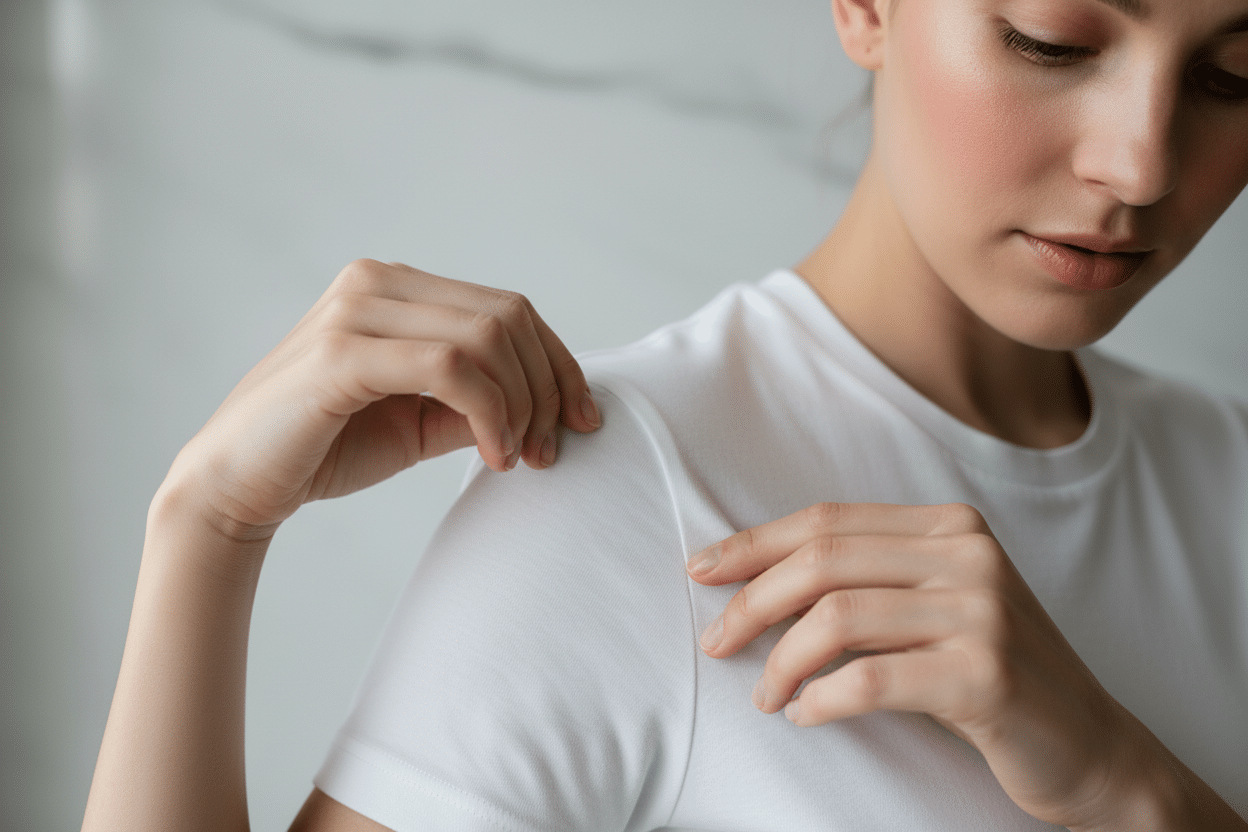
Start with quality. A 100% combed cotton tee in a substantial weight (around 180-200g/m²) holds its shape, drapes well, and photographs cleanly. Avoid thin, semi-transparent fabrics unless layering is intentional. The fit matters as much as the fabric: a slightly oversized tee worn with tailored wide-leg trousers creates proportion; the same tee worn with baggy bottoms reads as unintentional.
For beauty-forward looks, the T-shirt works best as a contrast element. Bold, editorial makeup paired with a plain white tee creates the visual tension that makes both elements stronger. Conversely, a heavily graphic tee calls for restraint elsewhere — clean skin, simple hair, minimal accessories.
Accessories and layering to elevate the basic
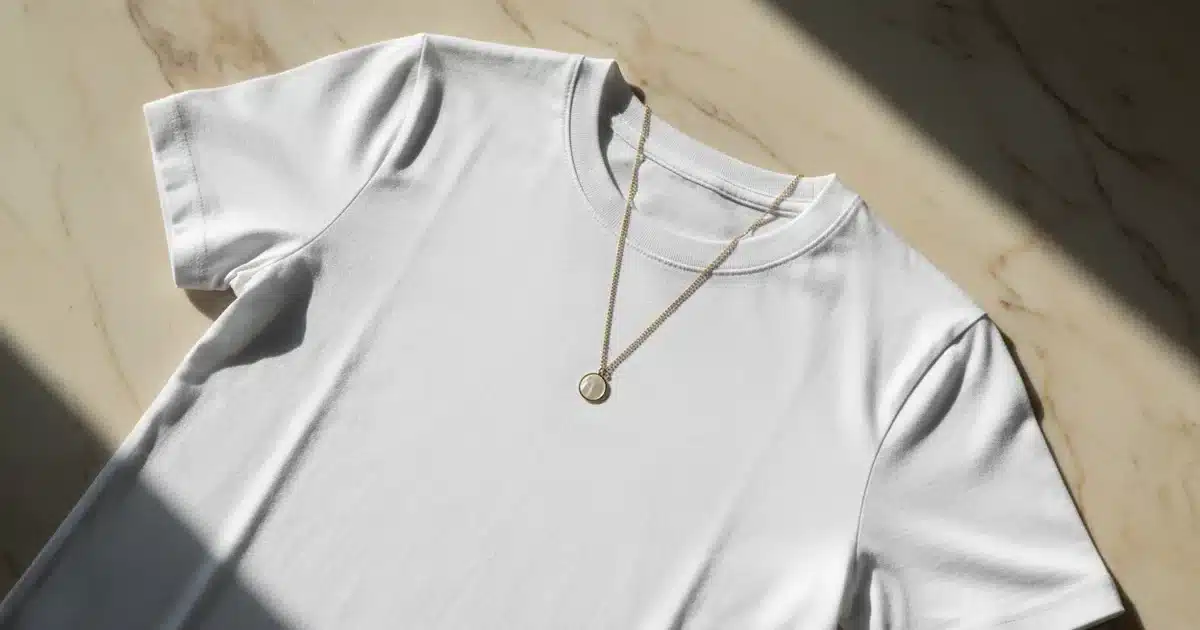
Jewelry transforms a T-shirt faster than any other styling choice. A chunky gold chain worn over a white fitted tee is a complete look. Layering a T-shirt under a slip dress creates texture and dimension. Tucking a tee into a structured midi skirt shifts the garment from casual to intentional immediately.
Hair and makeup choices seal the aesthetic. The "clean girl" tee look demands precisely that — clean, luminous skin and hair pulled back with intention. A grunge-adjacent graphic tee pairs naturally with smudged liner and undone waves. The T-shirt doesn't dictate these choices, but it creates the frame within which they make sense.
When building a beauty-forward T-shirt look, choose one focal point — either the tee’s graphic, your makeup, or your accessories. Competing focal points dilute the overall effect. Restraint in one area always amplifies another.
The T-shirt's genius lies precisely in what the "T" represents beyond its shape: a template. Blank enough to receive any identity, structured enough to hold it. In beauty culture, that combination is rare and worth taking seriously.